PhiCube described in Frontiers in Medicine
The design of PhiCube — its architecture, its reconfiguration mechanism and its bilateral controller — has been published in Frontiers in Medicine.
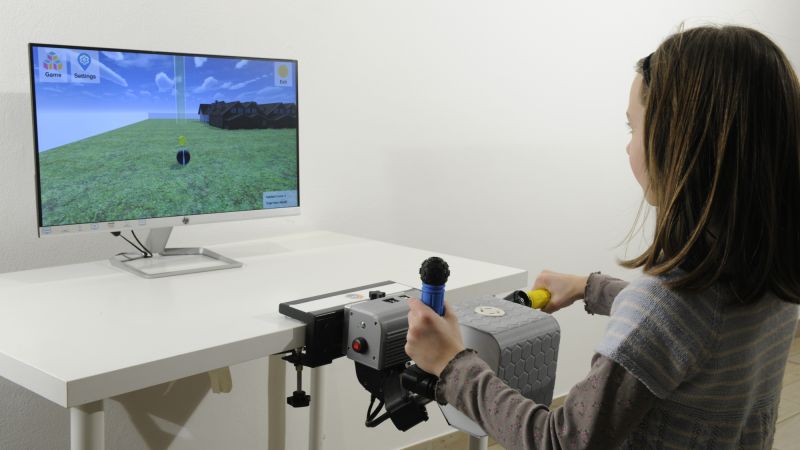
A paper describing PhiCube has been published in Frontiers in Medicine. It sets out the device’s architecture, the mechanism that lets it be reconfigured, and the impedance-based controller that governs how a patient’s two limbs are coupled during a session.
PhiCube began as an attempt to replace a set of rigid, single-purpose tools with one reconfigurable device for bilateral upper-limb rehabilitation in children. The paper describes two independent motorised rotational joints whose axes can be aligned with any of the three principal anatomical planes, together with interchangeable manipulanda that target different parts of the upper-limb kinematic chain. Kinematic simulations reported in the study show that each combination of handle and orientation recruits a distinct pattern of joints, from isolated distal training to multi-joint synergies.
The bilateral controller treats the relationship between the two limbs — its direction, its asymmetry and its stiffness — as tuneable parameters. That is what allows a single device to cover a range of therapeutic modalities, from one limb guiding the other to fully symmetric coordination training.
The paper is by Matteo Lavit Nicora, Giovanni Tauro, Atul Chaudhary, Davide Felice Redaelli and Matteo Malosio, and follows several years of prototypes, revisions and testing with the clinicians and patients who used them.